Skip to content
One Pager Template

Startup One Pager Template

An investor one-pager in six sections: problem, solution, market, traction, team and the ask. Download it or fill it in with the maker.

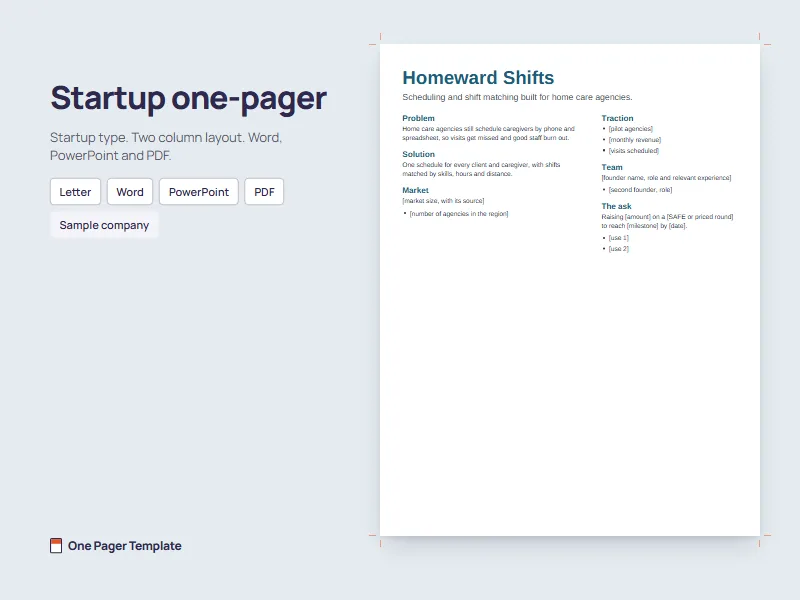
Startup one-pager template preview, filled in for a made-up Sample company

Startup one-pager template

Startup sections, two column layout, US Letter. Every section holds a bracketed prompt.

For Google Docs or Google Slides: download the file, then upload it to Google Drive and open it there.

Fill it in with the maker

The same six sections open in the one pager template maker, which keeps your text in your browser while you write.

What a startup one-pager needs

Title Tagline: who it is for and what they get Problem Solution Market The ask Traction Team
Problem
Who has the problem and what it costs them now. Specific enough that an investor can picture the customer.
Solution
What you built and why it works where the current options do not. Product, not vision.
Market
Who buys and how many of them there are, with the source of the figure on the page. A market figure without a source reads as a guess.
Traction (sidebar)
Dated numbers that show momentum: revenue, customers, pilots, letters of intent. Optional for very early companies, but say plainly what stage you are at.
Team (sidebar)
The founders' names, roles and the experience that makes them the people to solve this. One line each.
The ask
How much you are raising, on what terms, what it will achieve and where the money goes. The section that tells an investor exactly what you want.

How to word the funding ask

Many one-pagers skip the ask or bury it in adjectives. These lines state it plainly. Every figure stays in brackets until you have the real one:

  1. We are raising [amount] on a [SAFE, convertible note or priced round] to reach [milestone] by [date].
  2. The money goes to [use 1], [use 2] and [use 3].
  3. [Amount] is committed from [investors who agreed to be named]. (Only if true.)
  4. This gives us [months] of runway.
  5. We are looking for [the kind of investor] and can share [the deck or data room] on request.
Amount
The total for this round, not a range you hope to land in.
Round type
A SAFE, a convertible note or a priced round. Name the one you are offering.
Milestone
What the money buys in progress: a launch, a number of customers, the next round's proof.
Use of funds
Three buckets at most, such as hiring, product and sales. More reads as no plan.
Committed money
Only money that is actually committed, from investors who agreed to be named. Never imply a commitment you do not have.
Runway
How many months of cash the round gives you at the planned spend.
The investor you want
Stage, sector or the help you need, so the wrong investors can pass quickly.

The rule for every line: fill each bracket with a real figure or cut the line. Never round up, and never guess.

Traction lines without invented numbers

Traction is only convincing when it is dated and real. Use whichever of these you can fill honestly:

  • [Monthly revenue] as of [month and year].
  • [Number] paying customers, up [growth] since [month].
  • [Number] signed pilots with [type of customer].
  • [Letters of intent] from [who].
  • [Waitlist count] since [date].

Before revenue, say so and show the traction you do have, such as pilots, letters of intent or a waitlist. "Pre-revenue, with signed pilots at [number] clinics" is stronger than a vague promise, because it can be checked.

One-pager, pitch deck or executive summary

TopicWhat it isLengthWhen investors see itWhat it must do
One-pagerThe whole pitch on a single pageOne pageFirst contact, or forwarded by someone they knowEarn a meeting
Pitch deckA set of slides that tells the full storyA slide deckIn the meeting, or just after itTell the full story
Executive summaryA written summary, often the start of a business planOne to two pagesWhen they ask for oneSum up the plan in prose

The difference between a one-pager and the other short documents in other settings is in what is a one pager. If you are writing for customers rather than investors, use the business one pager template.

What gets a one-pager passed over

  • No clear ask. Fix: one sentence with the amount, the round and the milestone.
  • Jargon. Fix: describe the product the way a customer would.
  • More than one page. Fix: cut to the page and offer the deck for the rest.
  • A market figure with no source. Fix: name the source next to the number, or leave it out.
  • Vague traction, such as "growing fast". Fix: a dated number, or an honest statement of your stage.
  • No team. Fix: names, roles and one line on why each person fits.
  • The key line buried under design. Fix: the ask and the traction in plain type, where the eye lands first.

For the layout and the final checks, follow how to make a one pager.

Sharing it safely

Write the page as if it will be forwarded, because it often is, sometimes well beyond the person you sent it to. Many investors will not sign a nondisclosure agreement just to read a pitch, so put nothing on the page you could not share publicly. Keep detailed financials, customer names you do not have permission to use and technical secrets for later conversations. Send it as a PDF so nobody edits it by accident. And while you draft it, the maker on this site keeps your text in your browser and never uploads it.

A filled example

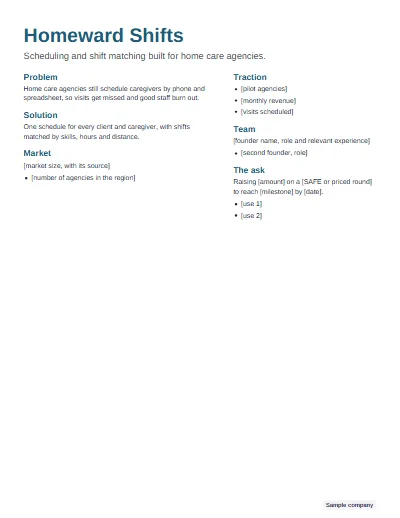
Sample company: Homeward Shifts, a startup one-pager in the Two column layout
Sample company

Startup one-pager: home care scheduling

Startup one-pager, Two column layout, Ocean

Homeward Shifts

Scheduling and shift matching built for home care agencies.

Problem

Home care agencies still schedule caregivers by phone and spreadsheet, so visits get missed and good staff burn out.

Solution

One schedule for every client and caregiver, with shifts matched by skills, hours and distance.

Market

[market size, with its source]

  • [number of agencies in the region]

Traction

  • [pilot agencies]
  • [monthly revenue]
  • [visits scheduled]

Team

[founder name, role and relevant experience]

  • [second founder, role]

The ask

Raising [amount] on a [SAFE or priced round] to reach [milestone] by [date].

  • [use 1]
  • [use 2]

A second startup page, a marketplace for inspected used lab equipment, is among the one pager examples.

Questions

What is a startup one pager?

A startup one pager is a single page that introduces a company to investors: the problem, the solution, the market, traction so far, the team and how much you are raising. Founders send it before a meeting or when asking for an introduction, and it is often forwarded inside a fund.

What should be on an investor one pager?

Six things: the problem and who has it, your solution, the market with a sourced figure, traction with dated numbers, the team and why it can win, and the ask, meaning how much you are raising, on what terms and what it will achieve. Add contact details and a one-line description at the top.

How do you state the funding ask on a one pager?

In one or two plain sentences: the amount, the type of round, what the money will achieve and by when, then where it goes. For example: we are raising [amount] on a [type of round] to reach [milestone] by [date], spent on [use 1] and [use 2]. Fill every bracket with real figures before sending.

Should a startup one pager include financials?

Include the few numbers that show momentum, such as revenue, growth or paying customers, each with its date, plus how much you are raising. Leave detailed projections, cap tables and full statements for the data room or a follow-up. If you are pre-revenue, show real traction of another kind, such as signed pilots.

What is the difference between a one pager and a pitch deck?

A pitch deck is a set of slides that tells the full story, usually presented in a meeting or read in detail. A one pager is the short version on a single page, built to earn that meeting and easy to forward. Many founders make both, with the same numbers in each.

Can I send a one pager before a pitch deck?

Yes, and it can be a good first step: it is quick to read, easy to forward to a partner, and it gives the investor a reason to ask for the deck. Keep the numbers identical in both, and have the deck ready to send the same day if they reply.

Should I mark my startup one pager confidential?

You can, but treat it as if it will be forwarded, because it often is, and many investors will not sign a nondisclosure agreement just to read a pitch. Put nothing on the page you could not share publicly; keep detailed financials, customer names you lack permission for and technical secrets for later conversations.