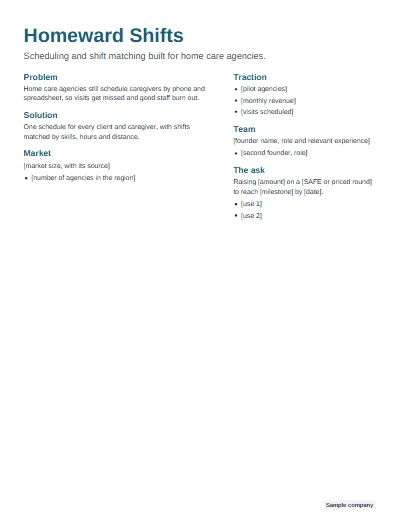
Prefer to start from your own notes? The one pager template maker lays out the same five sections and fits them to one page.
Two kinds of product one-pager
The name means two different documents depending on who you ask. Marketers mean a sheet for customers. Product managers mean an internal page that gets a team to agree on what to build.
Topic
Product sheet (for customers)
Product manager's one-pager (for the team)
Reader
Buyers and prospects
Engineering, design, leadership
Goal
Sell the product
Agree what to build and why
Sections
Problem, features, specs, pricing, next step
Goal, success measure, background, must-haves, out of scope, competition, key dates
Where it goes
Sent as a PDF or printed
A shared document
The template on this page is the product sheet; the internal version is explained further down. If you need to present the whole business rather than one product, use a company one pager instead.
What a product sheet needs
The product type has five sections. Specs and pricing are optional and sit in the side column of the wireframe; in the template's card grid layout every section gets a tinted card of its own, two to a row.
The problem
Two or three lines in the buyer's own words: what goes wrong without your product. If the buyer would not say it that way, rewrite it until they would.
Features
The features that change the buyer's day, each written as a benefit. A sentence plus up to three bullets keeps the card readable.
Specs (sidebar)
The few measurements buyers compare between products: size, weight, materials, compatibility, warranty. Optional, and best as short label and value pairs.
Pricing (sidebar)
A price, a starting price or "pricing on request". Optional: leave the box as a placeholder until you know which you will show.
Next step
One action and where to take it: order, request a sample, book a demo. Two competing actions split the reader's attention.
Writing features that sell
A feature is what the product has; a benefit is what the buyer gets. Join them in one line with "so you can":
Part
Format
Sample company line
Feature
[Feature], so you can [benefit].
Dimmable warm to cool light, so you can match the lamp to the time of day.
Compare the two halves of that first line. "Dimmable LED" is a spec-sheet fact. "So you can match the lamp to the time of day" is the reason a buyer cares. Put the feature buyers ask about most at the top of the list, and keep every feature to one line.
Only list the specs buyers actually compare; the rest belong in a manual. And when the page sells a whole offer, such as a service bundle or a subscription, rather than one product, a sales one pager has the better section set.
The product manager's one-pager
Inside a company, a product one-pager is the short case for building something. It comes before detailed requirements, and its job is to get engineering, design and leadership to agree on direction. The usual sections:
The goal: the problem this solves and for whom, in two sentences.
How success is measured: the one or two signals that will show it worked.
Background: why now, and what the team learned that points here.
Must-haves: the few things the first version cannot ship without.
Out of scope: what you are deliberately not building, which heads off most scope creep.
Competition and alternatives: what customers use today instead.
Key dates and owners: milestones, and one name against each.
Its readers are the people who have to agree before work starts, often in a short meeting where everyone reads the page first. Write it so that someone who joins the project next month could follow it without a briefing.
Keep decisions on the page and push detail into linked documents. A PRD, the product requirements document, comes later and runs long: user stories, edge cases and acceptance criteria. The one-pager stays short and early, about direction rather than specification. To lay one out with the maker, the project preset comes closest, with goal, scope, timeline, owners, risks and success measures; see the project one pager examples.
A filled example
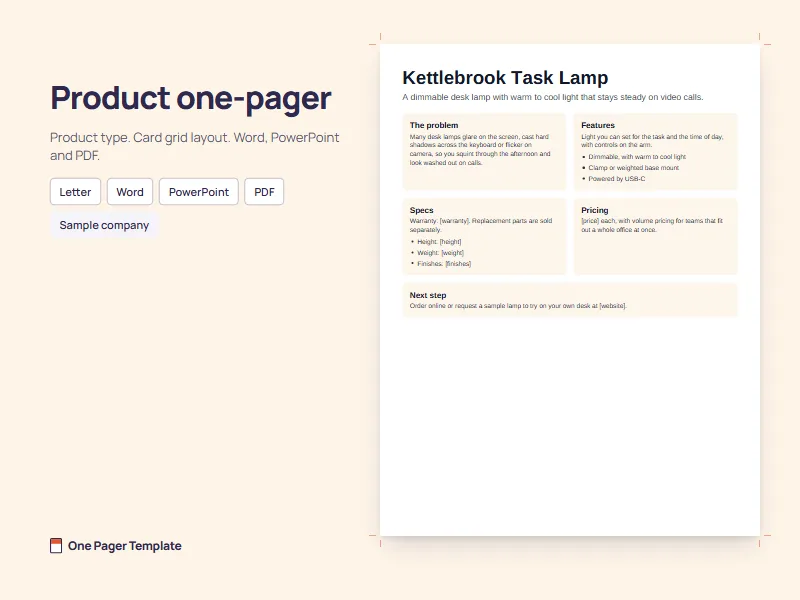
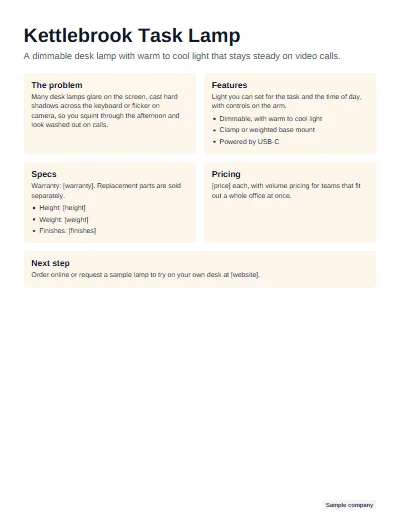
The Kettlebrook Task Lamp, from a made-up lighting company, keeps its height, weight, finishes, warranty and price in brackets. Fill those only with measured, current values: a wrong spec on a product sheet turns into a return.
Sample company
Product one-pager: a desk lamp
Product one-pager, Card grid layout, Marigold
Kettlebrook Task Lamp
A dimmable desk lamp with warm to cool light that stays steady on video calls.
The problem
Many desk lamps glare on the screen, cast hard shadows across the keyboard or flicker on camera, so you squint through the afternoon and look washed out on calls.
Features
Light you can set for the task and the time of day, with controls on the arm.
Dimmable, with warm to cool light
Clamp or weighted base mount
Powered by USB-C
Specs
Warranty: [warranty]. Replacement parts are sold separately.
Height: [height]
Weight: [weight]
Finishes: [finishes]
Pricing
[price] each, with volume pricing for teams that fit out a whole office at once.
Next step
Order online or request a sample lamp to try on your own desk at [website].
A scheduling app for cafes, written in the two column layout, is among the one pager examples, along with sales and startup pages.
Questions
What is a product one pager?
It is one of two things. For customers, it is a single page that sells one product: the problem it solves, its features and specs, the price and how to buy. Inside a company, a product manager's one-pager sets out the goal, scope and success measures of something the team will build.
What goes in a product one pager for customers?
Start with the problem in the buyer's words, then three to five features written as benefits, key specs as short label and value pairs, pricing or a starting price, and one next step such as ordering or booking a demo. Add a product image or your logo if it helps, and keep it to one side.
What is a product one pager for a product manager?
It is a short internal document that gets a team to agree on what to build and why before work starts. It states the goal, how success will be measured, the background, the must-haves, what is out of scope, the competition and key dates, all on one page that stakeholders can read in a few minutes.
What is the difference between a product one pager and a PRD?
A PRD, or product requirements document, is the detailed version: user stories, requirements, edge cases and acceptance criteria, often many pages long. The one-pager comes first and stays short, covering the goal, the case for doing it and what success looks like, so the team agrees on direction before anyone writes requirements.
How long should a product one pager be?
One side of one page for either kind. For a customer sheet, that means a few lines per section and specs kept to the ones a buyer compares. For a product manager's version, it means stating decisions rather than every detail, with pointers to the longer documents.
Should I put prices on a product one pager?
Yes, if your price is fixed and public: buyers look for it, and a clear price saves a round of email. If prices vary by volume or setup, use a starting price or write that pricing is on request, and leave the pricing box as a placeholder until you know which you will show.
Is there a product one pager template in Word or Google Docs?
Yes. Download the Word file above for a product sheet with the five sections laid out; for Google Docs, upload it to Google Drive and open it there. The PowerPoint file opens in Google Slides the same way. Or fill it in with the maker first and download it finished.